
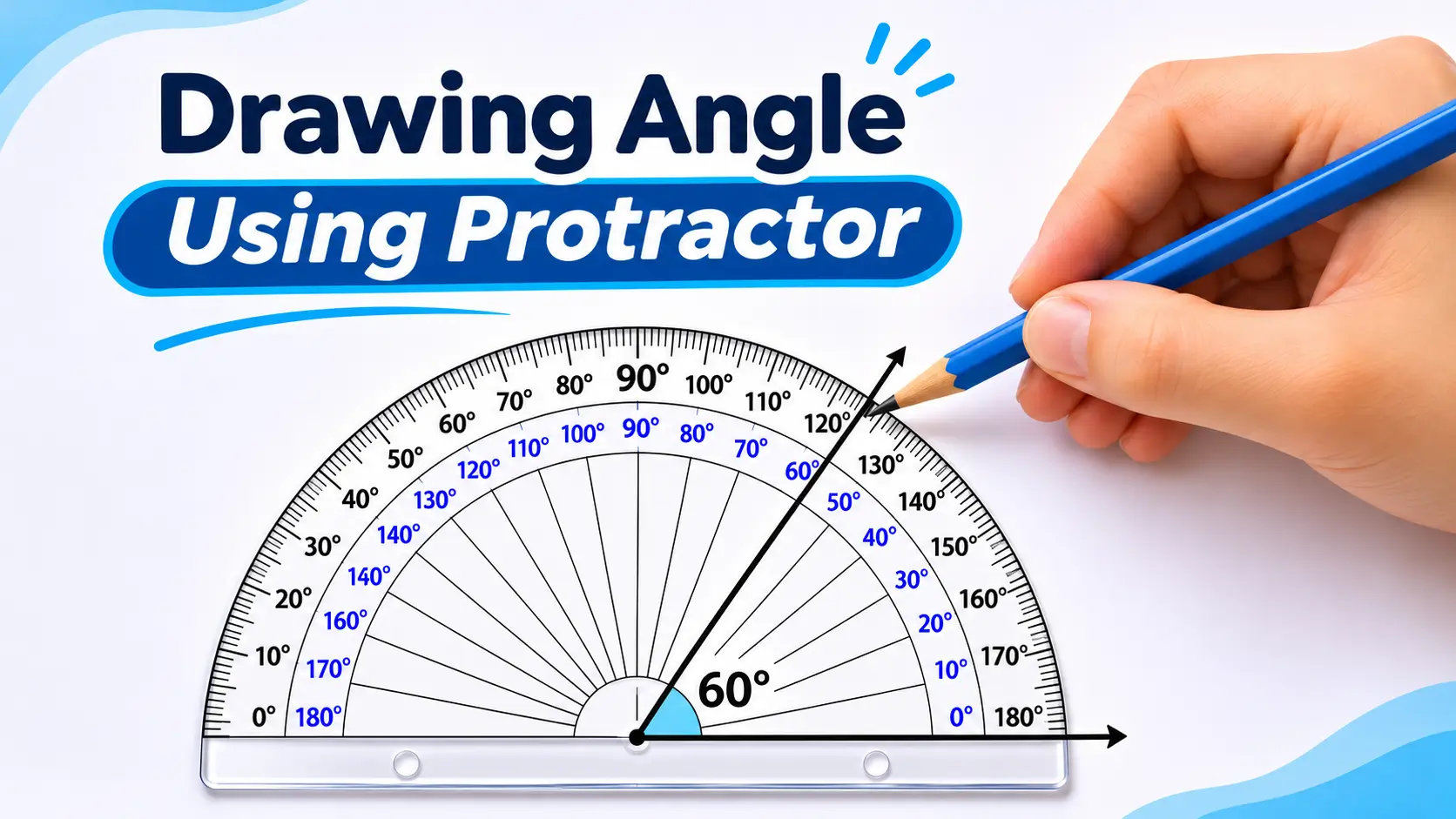

In this article, we will understand how to draw an angle using a protractor.
Table of Contents
Steps to draw an angle using protractor
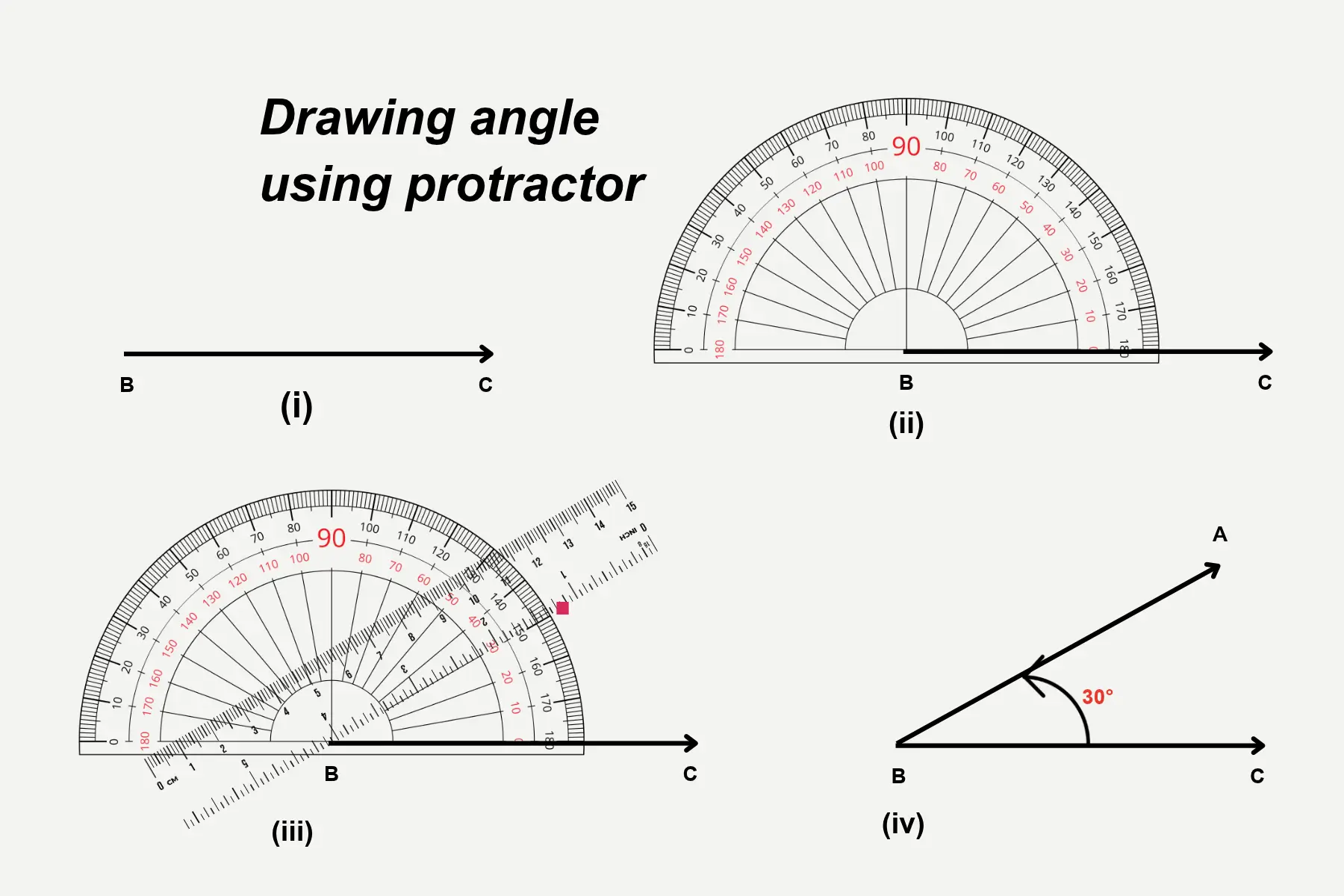
Suppose we would like to draw 30° using protractor and name it ∠ABC. In this angle, B is the vertex, BA and BC are the arms of the angle.
1. First, we take BC as reference base of the angle and draw it
2.Then we place the centre point of the protractor on B and align BC to the 0 line of the protractor
3. Now, starting from 0, we count degrees up to 30 on the protractor and mark point A at the label 30°.
4. Using a scale, point A and B are joined , ∠ABC= 30° is the required angle
CBSE Class 6 Solved Figure It Out Questions on Page 50
Below is a video on solved figure it out questions given on page 50 of Ganita Prakash book of CBSE board class 6
Usefulness of learning to draw angle using protractor in Real World
Learning to draw angles using a protractor is not just a classroom activity. It is a practical skill that helps us understand shapes, directions, and measurements in everyday life. Accurate angles are important in many professions and daily activities.
Where Do We Use Angles in Real Life?
1. Architecture and Construction: Architects and engineers use angles to design buildings, roofs, bridges, and staircases accurately.
2. Carpentry and Furniture Making: Carpenters use angles to cut wooden pieces and create furniture with precise corners and joints.
3. Art and Design: Artists use protractors to create geometric patterns, decorative designs, and symmetrical artwork.
4. Road and Map Planning: Engineers use angles to design road intersections and turns, while angles also help us understand directions on maps.
5. Clocks: The hands of a clock form different angles. For example, at 3:00, the hour and minute hands form a right angle (90°).
6. Science and Engineering: Angles are used to understand the direction of light, the movement of objects, and the design of machines.
Why Is Learning to Draw Angles Important?
Drawing angles using a protractor helps students improve their measurement accuracy, spatial reasoning, and problem-solving skills. It also builds a strong foundation for advanced geometry, trigonometry, engineering, and technical drawing.
In simple words: When we learn to draw angles accurately, we are learning a skill that connects mathematics to the world around us.