

Through this article, an introduction to Trigonometric functions is provided. Firstly, we revisit definition of Relations and Functions so that foundation of the student is strong as definition of function is derived from definition of relation and understanding what is a function helps understand ‘Trigonometric Function’, then we move on to understand difference between Trigonometric Ratios and Trigonometric Functions. Further, we discuss more about Trigonometric Functions.
Table of Contents
Revisiting Relations and Functions
Before discussing about Trigonometric Functions, let us revisit concepts of Relations and Functions.
Relations Meaning With Example
Relation Definition: A relation R from a non-empty set A to a non-empty set B is a subset of the cartesian product A × B. The subset is found out by describing a relationship between the first element and the second element of the ordered pairs in A × B. The second element is called the image of the first element.
Example to understand Relation:
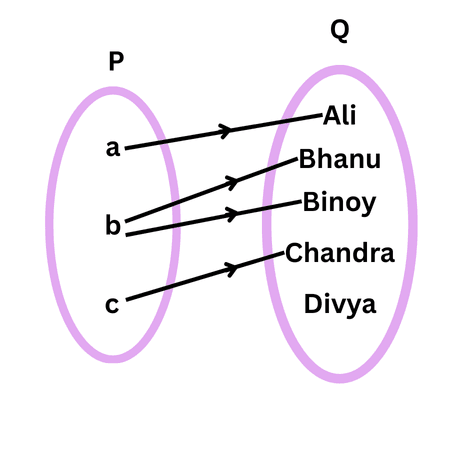
Consider the two sets P= {a, b, c} and Q = {Ali, Bhanu, Binoy, Chandra, Divya}.
The cartesian product of P and Q has 15 ordered pairs which can be listed as P × Q = {(a, Ali), (a, Bhanu), (a, Binoy),(a, Chandra), (a, Divya), (b, Ali), (b, Bhanu), (b, Binoy),(b, Chandra), (b, Divya), (c, Ali), (c, Bhanu), (c, Binoy),(c, Chandra), (c, Divya)}.
We can now obtain a subset of P x Q by introducing a relation R between the first element x and the second element y of each ordered pair (x,y) as
R = {(x,y) : x is the first letter of the name y, x ϵ P, y ϵ Q }
According to the Relation defined, then, R = { (a, Ali), (b, Bhanu), (b, Binoy), (c, Chandra) }
A visual representation of this relation R (called an arrow diagram) is shown in the image
The total number of relations that can be defined from a set A to a set B is the number of possible subsets of A × B.
If n(A) = p and n(B) = q, then
n (A x B) = pq and the total number of relations is 2pq
Function Meaning
A relation f from a set A to a set B is said to be a function if every element of set A has one and only one image in set B.
In other words, a function f is a relation from a non-empty set A to a non-empty set B such that the domain of f is A and no two distinct ordered pairs in f have the same first element.
If f is a function from A to B and (a, b) ∈ f, then f (a) = b, where b is called the image of a under f and a is called the preimage of b under f.
The function f from A to B is denoted by f: A → B. A is called the domain of f and B is called the co-domain of f
A function assigns exactly one output to each input, however, different inputs can have the same output.
Example of a function: { (1,2), (2,4), (3,6), (4,8) }
This is a function because every input (first element) has exactly one output (second element).
Example of not a function : { (1,2), (2,4), (2,6), (3,8) }
This is not a function because the input 2 has two different outputs: 4 and 6
Trigonometric Functions
In Class 10, we studied trigonometric ratios mainly for acute angles in right-angled triangles. In Class 11, trigonometry is extended to angles of any magnitude, including negative angles and angles greater than 360°.
Now, we can define trigonometric functions for angles of any magnitude, including:
- Acute angles (30°, 45°)
- Obtuse angles (120°, 150°)
- Negative angles (-30°, -90°)
- Angles greater than 360° (450°, 720°)
Can we calculate sin 150° using the Class 10 right-angled triangle definition directly? No. Because 150° cannot be an acute angle of a right-angled triangle. But we can calculate it using the Class 11 trigonometric function approach.
Trigonometric functions are mathematical functions that associate a numerical value with an angle and describe the relationship between angles and coordinates on the unit circle(a unit circle is a circle with radius 1 unit)
There are six trigonometric functions:
- Sine (sin)
- Cosine (cos)
- Tangent (tan)
- Cosecant (cosec)
- Secant (sec)
- Cotangent (cot)
Unit Circle and Coordinates
We use the unit circle to understand trigonometric functions.
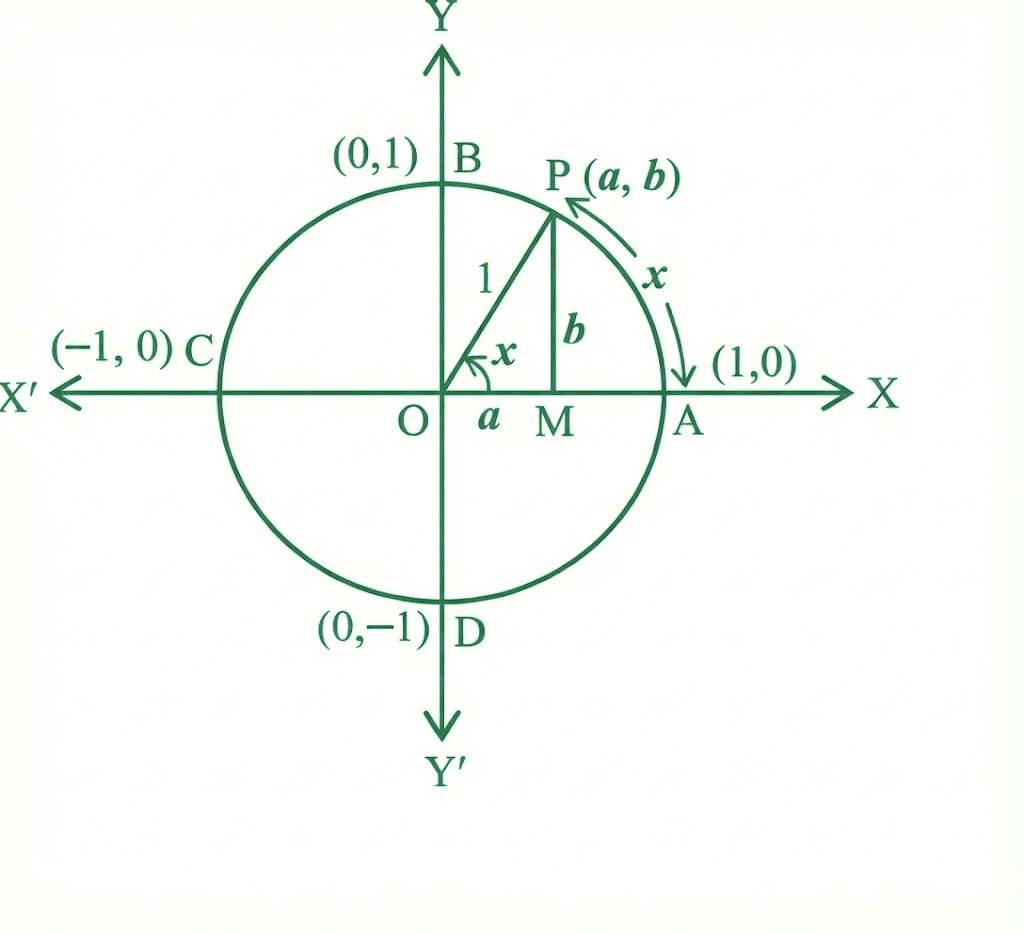
Consider a unit circle with centre at the origin of the coordinate axes. Let P (a, b) be any point on the circle with ∠AOP = x radian, i.e., length of arc AP = x
We define:
Right-Angled Triangle OMP
Since triangle OMP is a right-angled triangle, we have:
OM² + MP² = OP² or a² + b² = 1²
Thus, for every point on the unit circle, we have:
a² + b² = 1 or cos²x + sin²x = 1
cos²x + sin²x = 1 is one of the important Trigonometric Identities
Quadrantal Angles
Since one complete revolution subtends an angle of 2π radian at the centre of the circle,
∠AOB =
∠AOC = π
∠AOD =
All angles which are integral multiples of are called quadrantal angles.
The coordinates of the points A, B, C, and D are respectively: (1, 0), (0, 1), (–1, 0), and (0, –1)
Therefore, for quadrantal angles, we have:
- cos 0° = 1
- sin 0° = 0
- cos = 0
- sin = 1
- cos π = –1
- sin π = 0
- cos = 0
- sin = –1
- cos 2π = 1
- sin 2π = 0
Periodic Nature of Sine and Cosine
Now, if we take one complete revolution from the point P, we again come back to the same point P. Thus, we observe that if x increases (or decreases) by any integral multiple of 2π, the values of sine and cosine functions do not change.
Thus,
sin (2nπ + x) = sin x, n ∈ Z
cos (2nπ + x) = cos x, n ∈ Z
Zeros of Sine and Cosine
Further,
sin x = 0, if
x = 0, ±π, ±2π, ±3π, …
i.e., when x is an integral multiple of π.
cos x = 0, if
x = ±π/2, ±3π/2, ±5π/2, …
i.e., when x is an odd multiple of π/2.
Thus,
- sin x = 0 ⇒ x = nπ, where n is any integer
- cos x = 0 ⇒ x = (2n + 1)π/2, where n is any integer
Other Trigonometric Functions
We now define other trigonometric functions in terms of sine and cosine functions:
cosec x = , x ≠ nπ, where n is any integer
sec x = , x ≠ , where n is any integer
tan x = , x ≠ , where n is any integer
cot x = , x ≠ nπ, where n is any integer
Important Trigonometric Identities
We have shown that for all real x,
sin²x + cos²x = 1
It follows that:
- 1 + tan²x = sec²x
- 1 + cot²x = cosec²x
Trigonometric Ratios Table
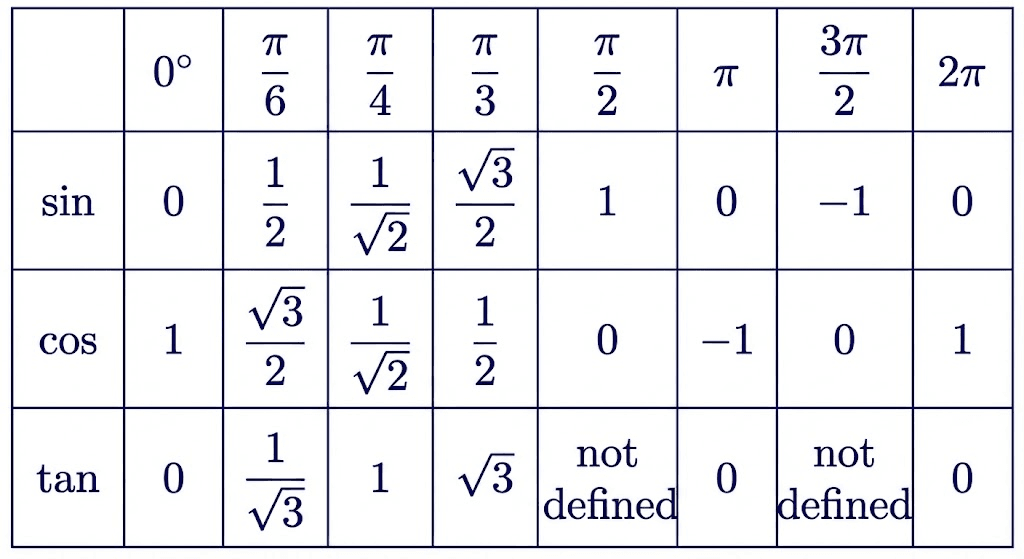
The values of cosec x, sec x and cot x are the reciprocal of the values of sin x, cos x and tan x, respectively.
Purpose of Studying About Trigonometric Functions
Trigonometric functions are useful mathematical tools that help us understand and solve problems involving angles, distances, heights, rotations and periodic phenomena. They are widely used in mathematics, physics, engineering, architecture, astronomy, navigation, computing and imaging and many other fields. They also help us study circular motion, waves and repeating patterns in nature.
Applications in Professional Life:
1. Civil Engineer / Surveyor
- Measuring land and building heights.
- Designing bridges, roads and tunnels.
- Calculating slopes and structural angles.
2. Architect / Interior Designer
- Designing roofs, stairs and curved structures.
- Calculating angles and dimensions.
- Creating accurate 2D and 3D designs.
3. Pilot / Aviation Professional
- Calculating directions and flight paths.
- Understanding navigation and angles of descent.
- Supporting aircraft positioning and navigation.
4. Robotics / Mechanical Engineer
- Calculating rotation of robotic arms.
- Controlling machine movements.
- Designing rotating components and mechanisms.
5. Game Developer / Animator
- Rotating objects in 3D environments.
- Creating realistic movements.
- Designing camera angles and animations.
6. Solar Energy Engineer
- Finding suitable solar panel tilt angles.
- Calculating sunlight direction.
- Improving the positioning of solar panels.
Applications in business and entrepreneurship:
- Construction business – Calculating roof slopes, building dimensions, staircase designs and land measurements.
2. Solar installation business – Choosing suitable panel orientations and tilt angles for different rooftops.
3. Drone mapping business – Measuring land, creating maps, estimating distances and analysing agricultural fields.
4. Manufacturing business – Designing machine components, controlling automated equipment and ensuring accurate alignment.
5. Telecommunication business – Analysing signals, antenna directions and wireless communication systems.