
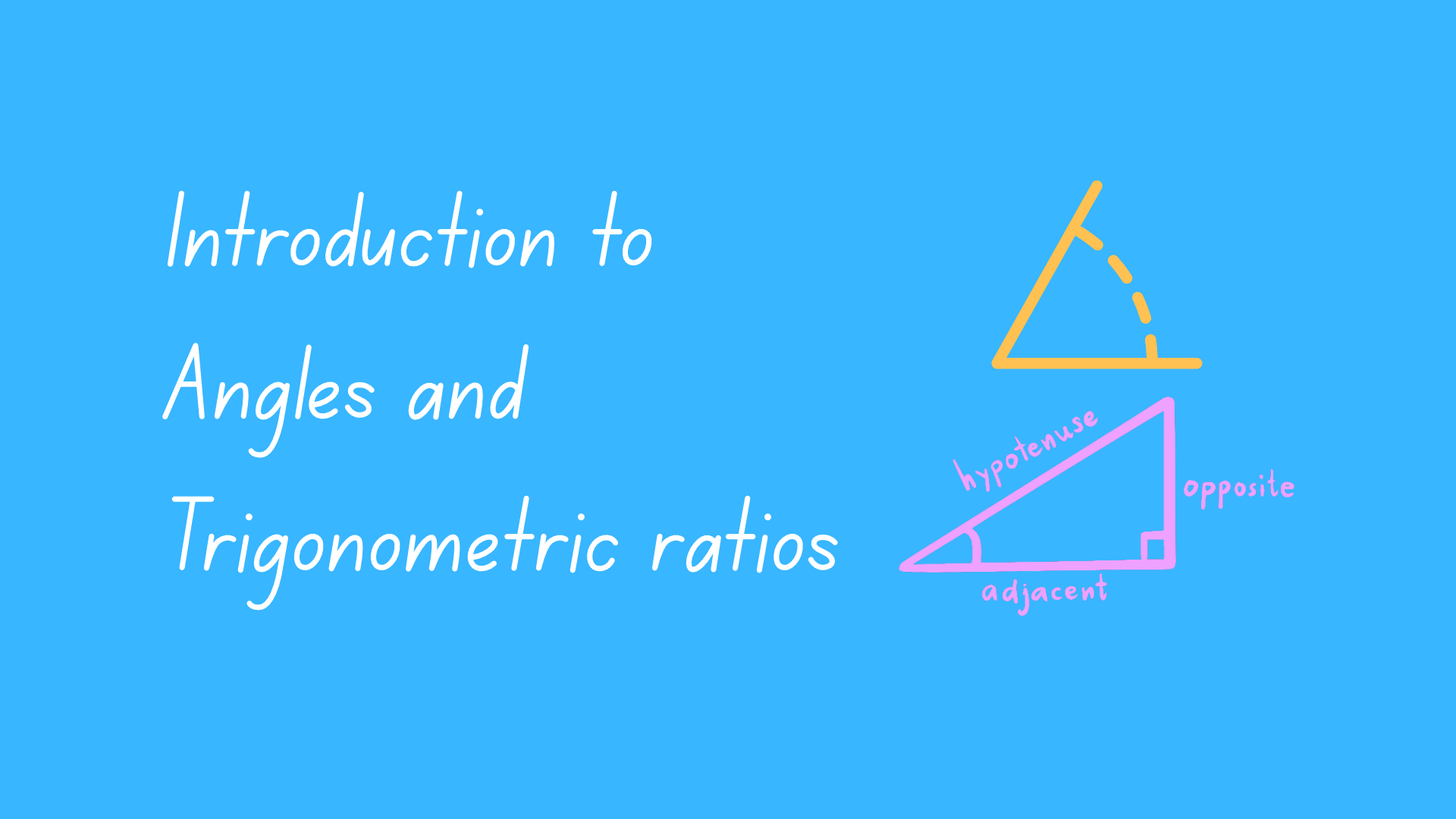

- This article gives an introduction to angles and trigonometric ratios
- The word ‘trigonometry’ is derived from the Greek words ‘trigon’ and ‘metron’ and it means ‘measuring the sides of a triangle’.
- The subject was originally developed to solve geometric problems involving triangles. It was studied by sea captains for navigation, surveyor to map out the new lands, by engineers and others.
- Currently, trigonometry is used in many areas such as the science of seismology(the scientific study of movements in the earth’s surface(earthquakes) ), designing electric circuits, describing the state of an atom, predicting the heights of tides in the ocean, analysing a musical tone and in many other areas.
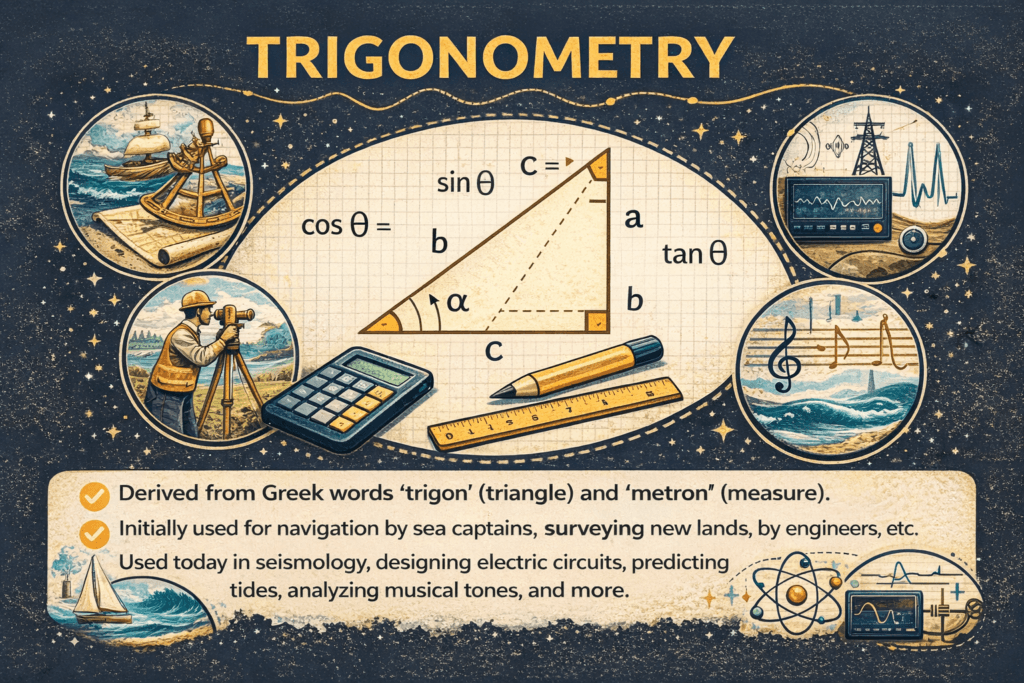
Table of Contents
Introduction to Angles
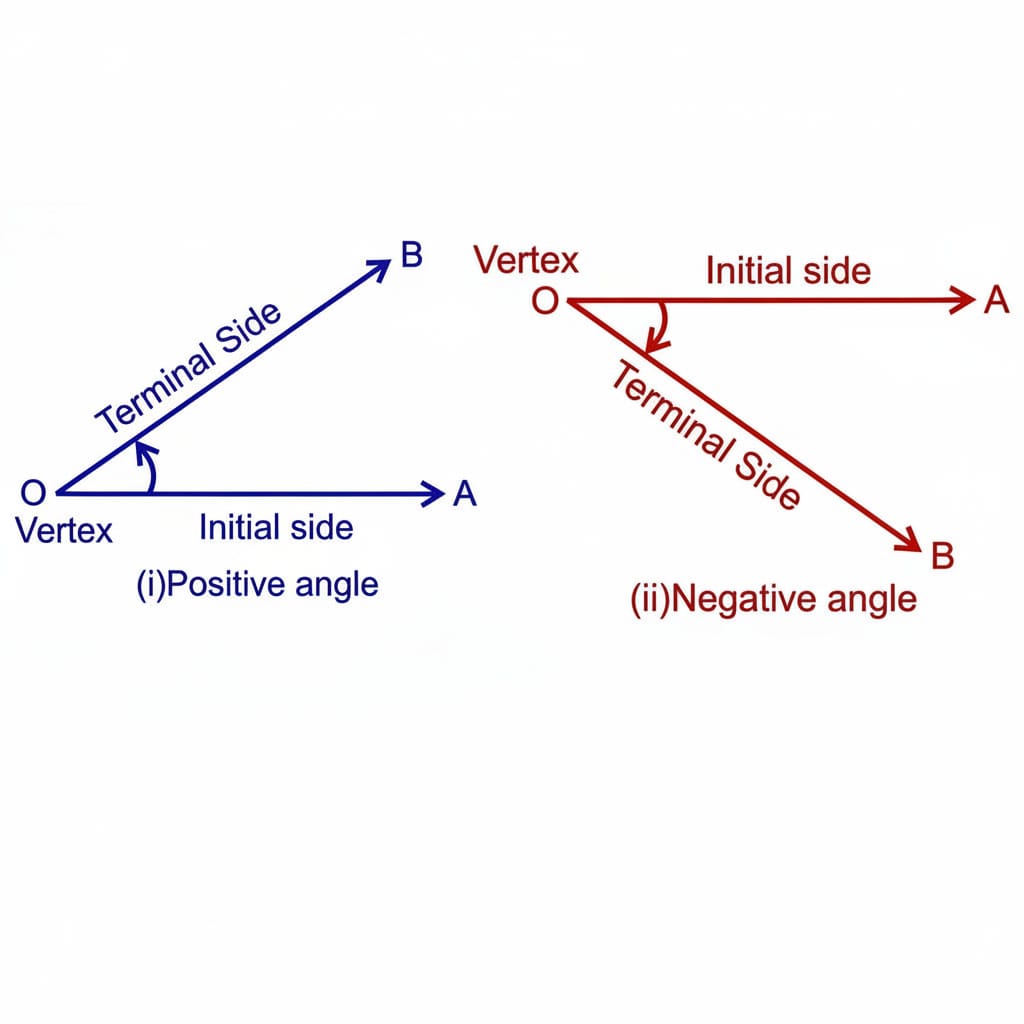
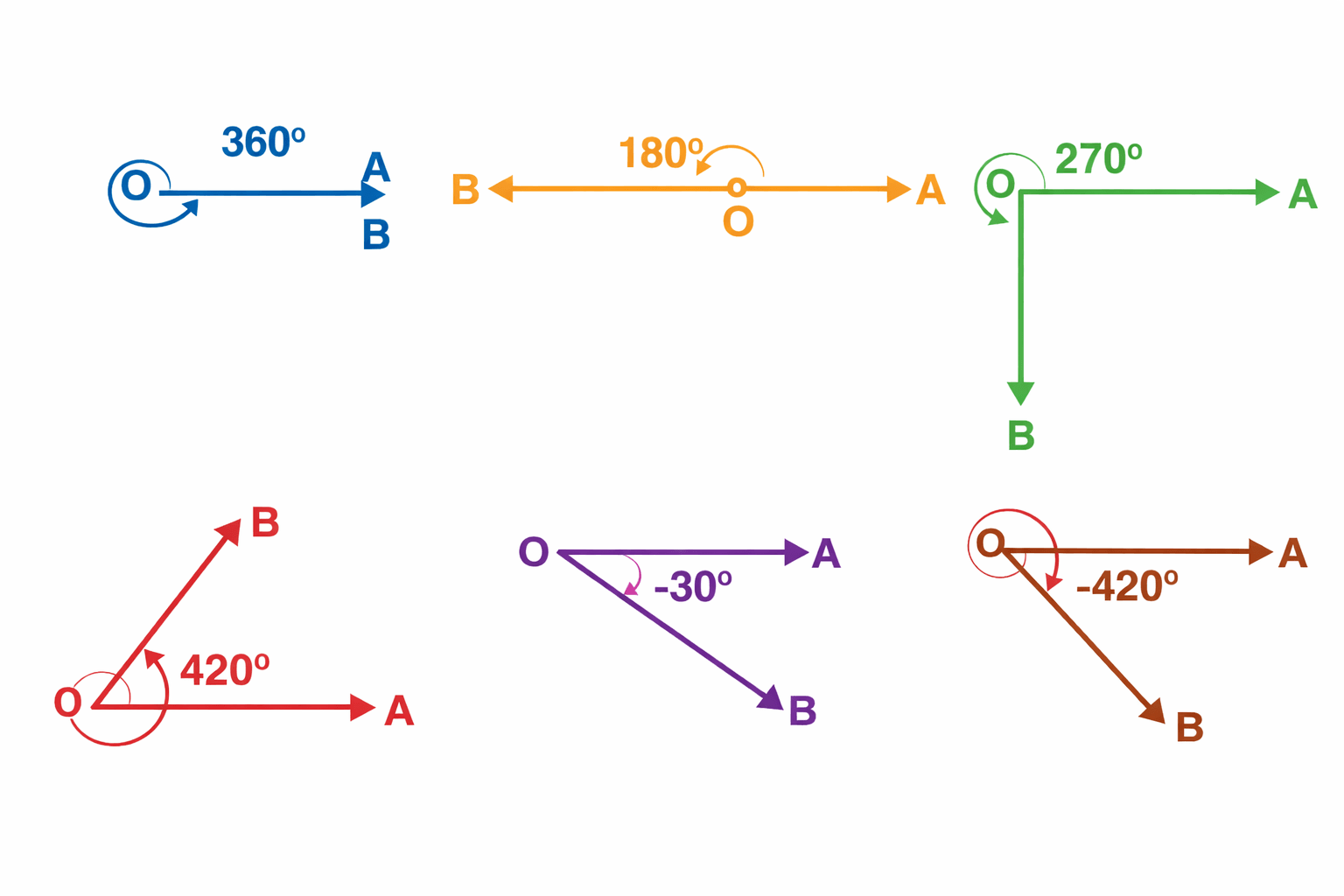
- Angle is a measure of rotation of a given ray about its initial point. The original ray is called the initial side and the final position of the ray after rotation is called the terminal side of the angle
- The point of rotation is called the vertex
- If the direction of rotation is anticlockwise, the angle is said to be positive and if the direction of rotation is clockwise, then the angle is negative
- The measure of an angle is the amount of rotation performed to get the terminal side from the initial side.
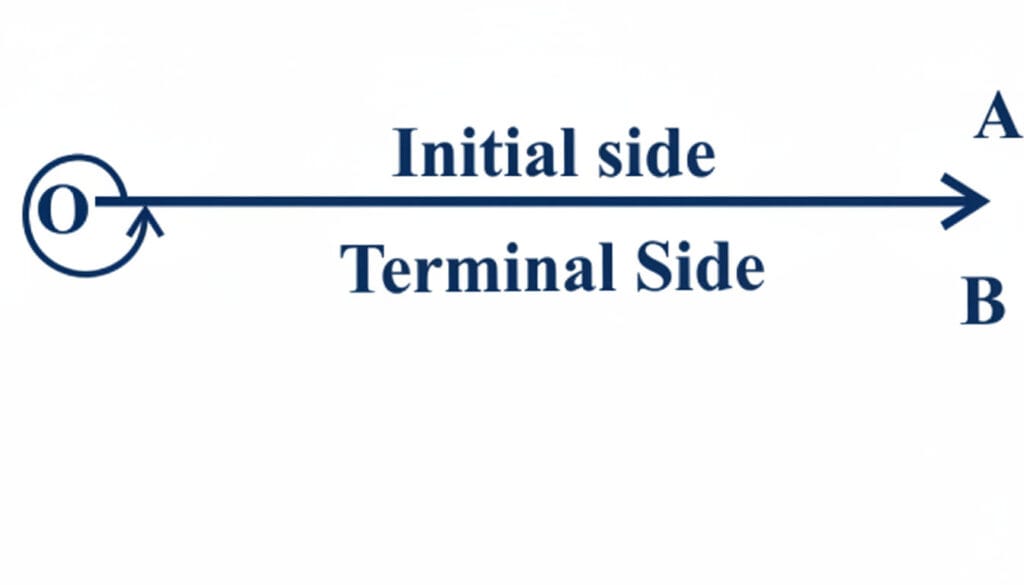
- The definition of an angle suggests a unit, namely, one complete revolution from the position of the initial side as indicated in figure
- For example, we can say that a rapidly spinning wheel is making an angle of say 15 revolution per second.

Below discussed are the two other units of measurement of an angle which are most commonly used, namely, degree measure and radian measure:
Degree Measure
- If a rotation from the initial side to terminal side is (¹⁄₃₆₀)th of a revolution, the angle is said to have a measure of one degree, written as 1°.
- A degree is divided into 60 minutes, and a minute is divided into 60 seconds . One sixtieth of a degree is called a minute, written as 1′, and one sixtieth of a minute is called a second, written as 1″
- 1° = 60′, 1′ = 60″
Shown below in the image are some angles with their initial and terminal side
Radian Measure
- Angle subtended at the centre by an arc of length 1 unit in a unit circle (circle of radius 1 unit) is said to have a measure of 1 radian
- In the figure below OA is the initial side, OB is the terminal side. The figure shows the angle whose measures are 1 radian, -1 radian, 1 ½ radian and -1 ½ radian
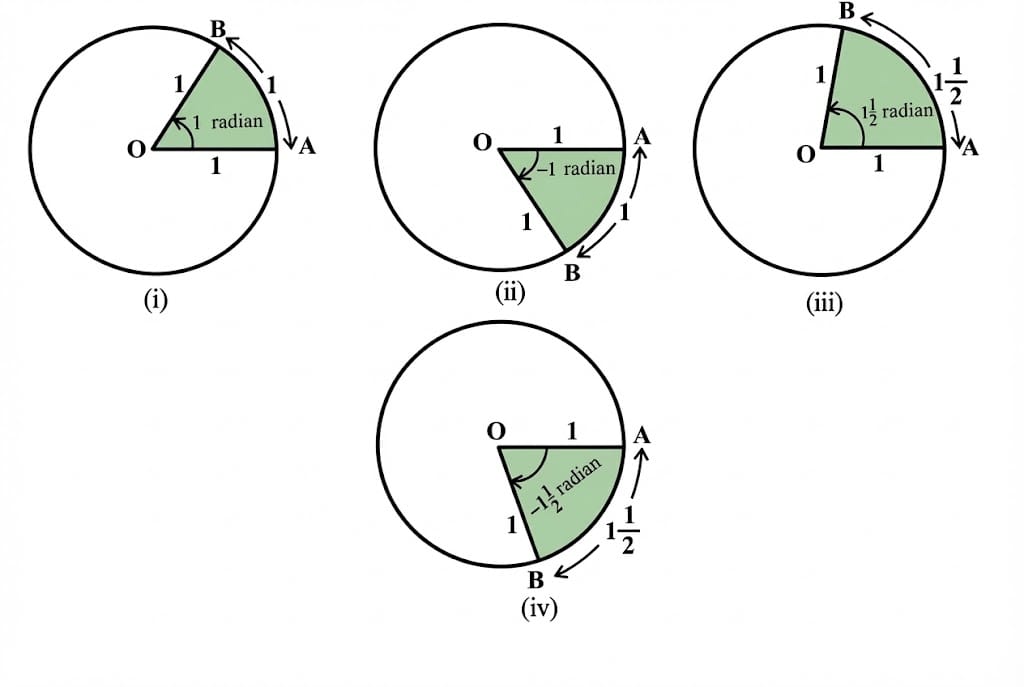
- The circumference of a circle of radius 1 unit is 2π. Thus, one complete revolution of the initial side subtends an angle of 2π radian
- Equal arcs of a circle subtend equal angle at the centre.
The statement “equal arcs of a circle subtend equal angles at the centre” is a fundamental theorem in geometry. It essentially means that if you have two pieces of the circle’s edge (arcs) that are exactly the same length, the “slices of pie” they create will have the exact same angle at the centre point.
3 Proofs for Equal Arcs Subtend Equal Angles
1. Geometric Logic (SSS Congruency)
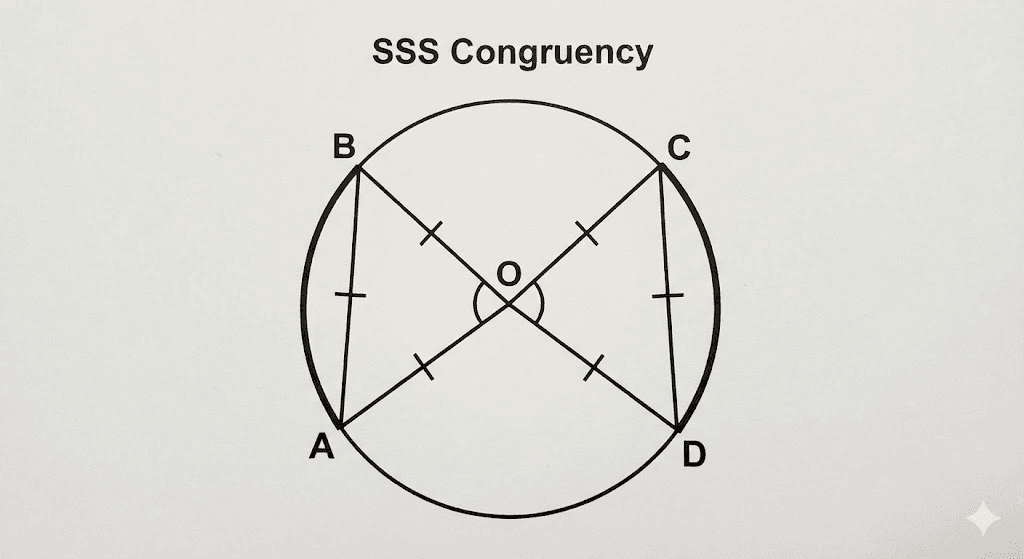
- Given: A circle with center O and two equal arcs, Arc AB and Arc CD.
- Radii: The segments OA, OB, OC, and OD are all equal because they are radii of the same circle.
- Chords: Because Arc AB = Arc CD, the straight-line chords connecting the endpoints (Chord AB and Chord CD) are also equal.
- Congruence: Triangle OAB and Triangle OCD are congruent by the SSS (Side-Side-Side) rule.
- Conclusion: Since the triangles are identical, their central angles must be equal: ∠AOB = ∠COD.
2. The Radian Formula Logic
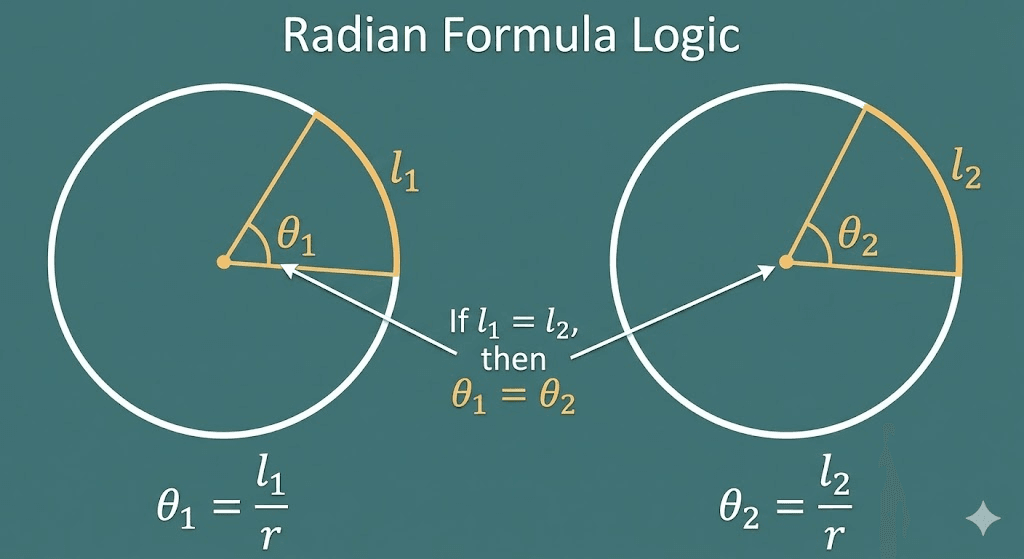
- The Formula: The relationship between angle (θ), arc length (l), and radius (r) is defined as
- Constant Radius: In any specific circle, the radius (r) is a constant value.
- Substitution: If you have two arcs where l₁ = l₂, then:
- Conclusion: Since the right sides of the equations are equal, the angles must be equal: θ₁ = θ₂.
3. Clock Intuition Logic (Uniformity)
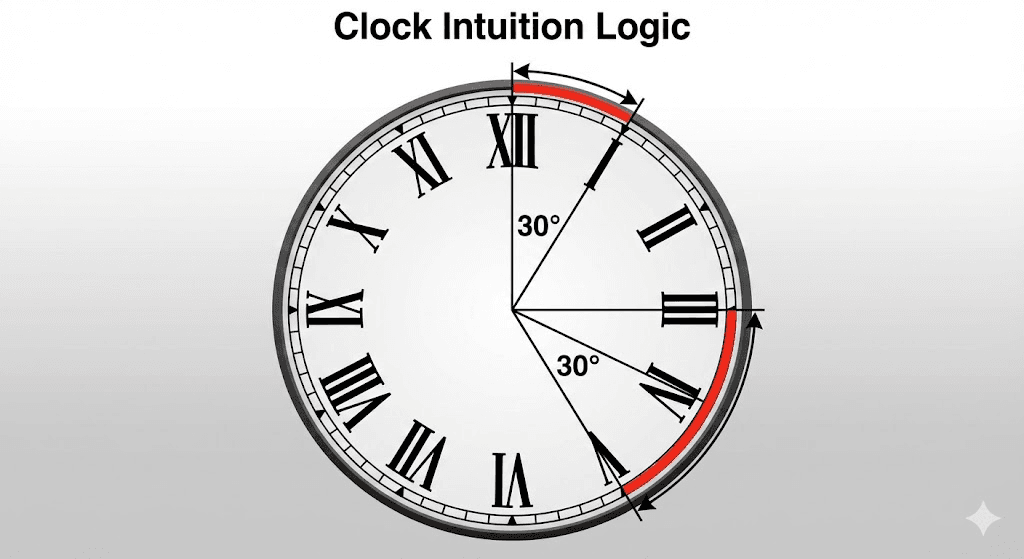
- Visualizing the Face: A clock is a perfect circle divided into 12 equal arcs (the distance between any two consecutive numbers).
- Observation: Because the arc length between 12 and 1 is identical to the arc length between 3 and 4, the “opening” at the center must be identical.
- Calculation: Since the total circumference(360° or 2π) is divided by equal lengths of arc, each segment must contain an equal share of the total angle.
- Conclusion: If 1/12th of the circle’s edge always equals 30° regardless of where it sits on the clock, then equal arcs must always subtend equal angles.
- In a circle of radius r, an arc of length r will subtend an angle of 1 radian.
- Since in a circle of radius r, an arc of length r subtends an angle whose measure is 1 radian, an arc of length l will subtend an angle whose measure is l/r radian. Thus, if in a circle of radius r, an arc of length l subtends an angle θ radian at the centre, we have θ = l/r or l = rθ
Relation between Radian and Real Numbers
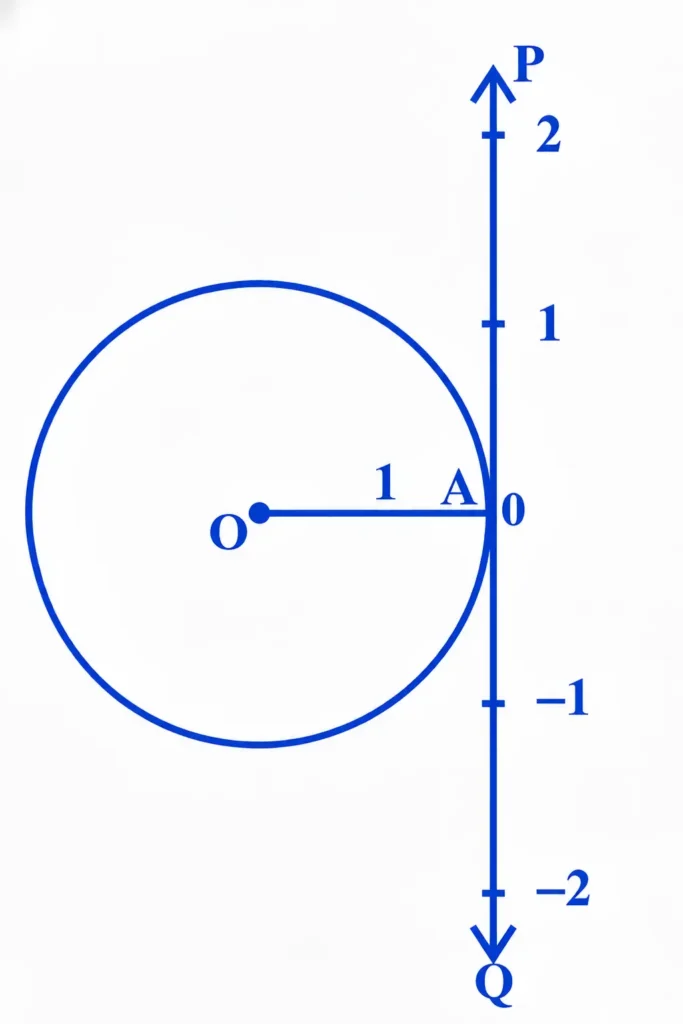
Consider the unit circle with centre O. Let A be any point on the circle. Consider OA as initial side of an angle.
Then the length of an arc of the circle will give the radian measure of the angle which the arc will subtend at the centre of the circle.
Consider the line PAQ which is tangent to the circle at A. Let the point A represent the real number zero, AP represents positive real number and AQ represents negative real numbers. If we rope the line AP in the anticlockwise direction along the circle, and AQ in the clockwise direction, then every real number will correspond to a radian measure and conversely.
Length of AP will be 2 units
Thus, radian measures and real numbers can be considered as one and the same.
Relation between Degree and Radian
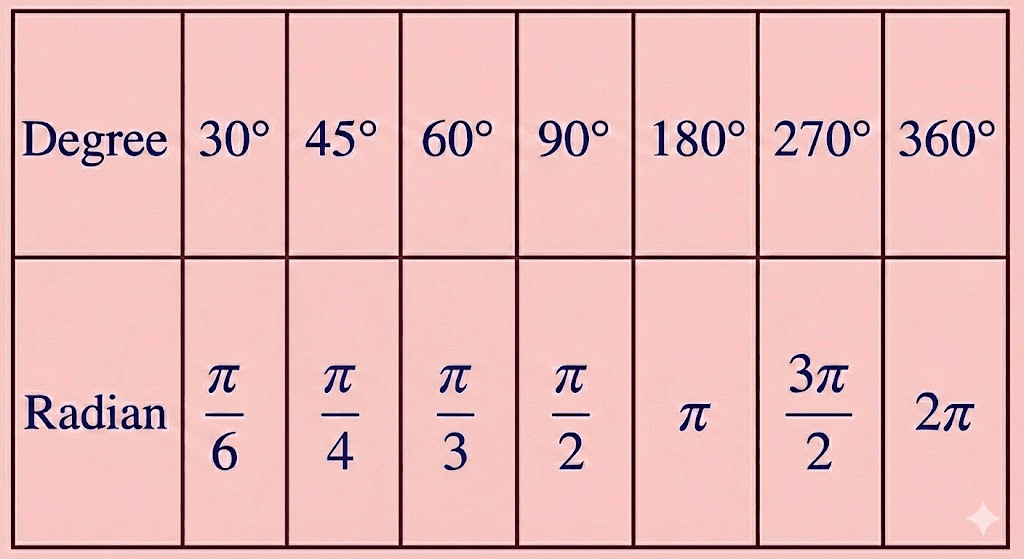
We know 2π radian = 360° or π radian = 180° ( as circle subtends angle at centre an angle whose radian measure is 2π and degree measure is 360° )
Using π value as 22/7 approximately:
1 radian = 180°/ π = 57°16‘ approximately
1° = π/180 radian = 0.01746 radian approximately
Notational Convention
- Whenever we write an angle θ°, we mean the angle whose degree measure is θ.
- Whenever we write an angle β, we mean the angle whose radian measure is β.
- Thus, π = 180°, π / 4 = 45° are written with the understanding that π and π / 4 are radian measures.
Conversion Formulae
Radian measure
= (π / 180) × Degree measure
Degree measure
= (180 / π) × Radian measure
Trigonometric Ratios
For an acute angle θ in a right-angled triangle, the trigonometric ratios express the relationship between the angle and the lengths of the right angled triangle’s sides.
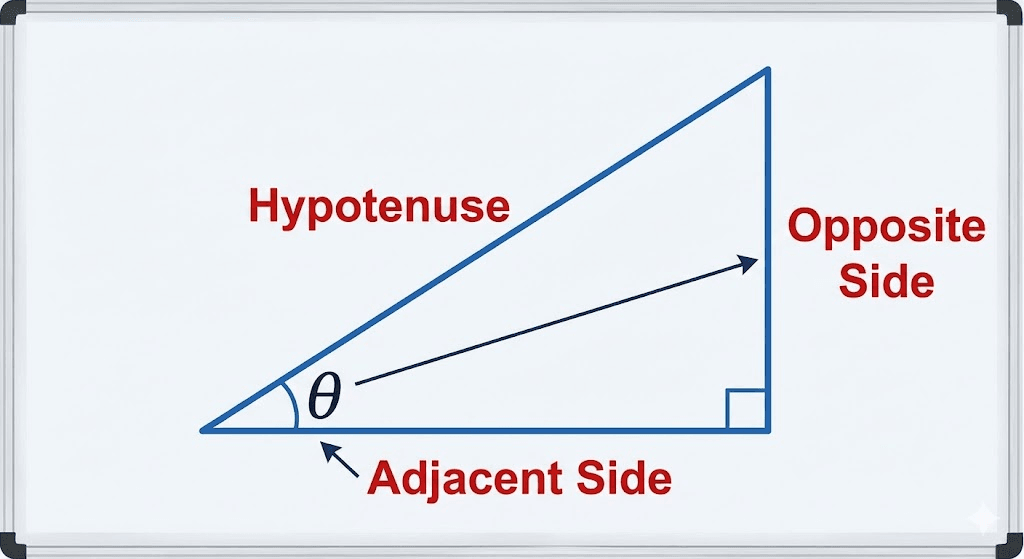
To define these, we first identify the sides relative to the angle θ:
- Hypotenuse: The longest side, opposite the right angle (90°).
- Opposite: The side directly across from angle θ.
- Adjacent: The side next to angle θ (that isn’t the hypotenuse).
1. Primary Trigonometric Ratios
These are the most commonly used ratios:
Sine (sin θ)
sin θ = Opposite Side / Hypotenuse
Cosine (cos θ)
cos θ = Adjacent Side / Hypotenuse
Tangent (tan θ)
tan θ = Opposite Side / Adjacent Side
2. Reciprocal Trigonometric Ratios
These are the reciprocals of the primary ratios:
Cosecant (cosec θ or csc θ)
(Reciprocal of Sine)
csc θ = Hypotenuse / Opposite Side
Secant (sec θ)
(Reciprocal of Cosine)
sec θ = Hypotenuse / Adjacent Side
Cotangent (cot θ)
(Reciprocal of Tangent)
cot θ = Adjacent Side / Opposite Side
Memory Aid: SOH CAH TOA
A common mnemonic to remember the primary ratios is SOH CAH TOA:
- SOH: Sine = Opposite / Hypotenuse
- CAH: Cosine = Adjacent / Hypotenuse
- TOA: Tangent = Opposite / Adjacent