
What is education? Why to get educated? How to get educated? Is education just textbooks and classrooms, or something far more powerful that shapes who we become?
Is education merely about reading books, passing exams and getting degrees? I don’t think so.
Let us explore.
According to me, education is the foundation of personal and societal growth. When personal growth happens, societal growth happens automatically.
Education, in its widest sense, is the process of acquiring knowledge, developing skills, building values and attitudes through various means, including formal institutions like schools and universities, as well as informal experiences in daily life.
Education empowers individuals, shapes their worldview, and equips them with the ability to make informed decisions.
In this article, we will explore the meaning and definition of education, its three main types, its importance in personal and social development, and how education helps us navigate an increasingly information-rich world.
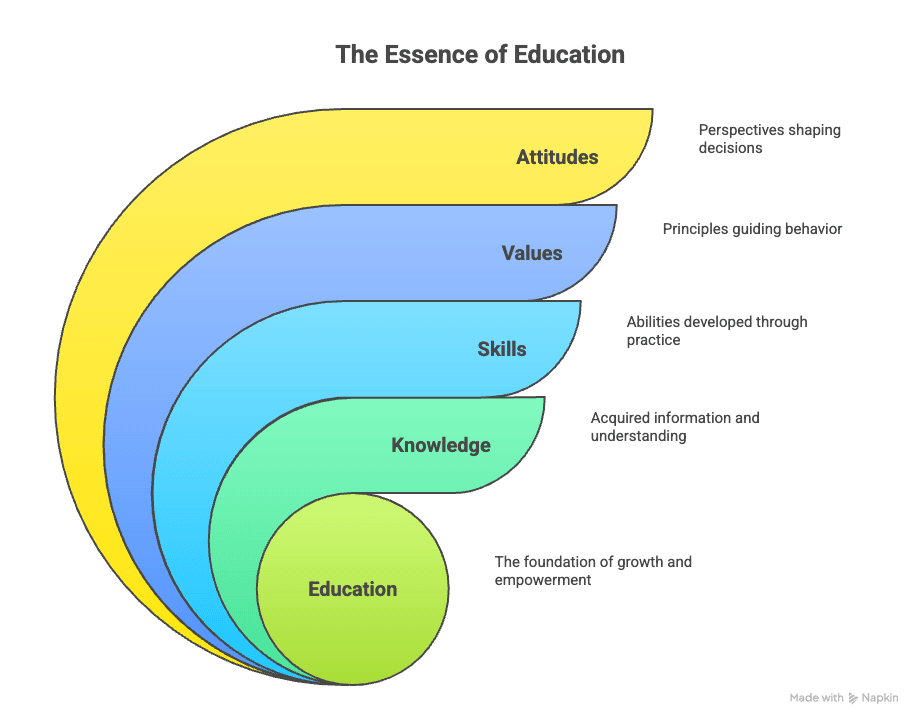
Table of Contents
The Meaning of Education
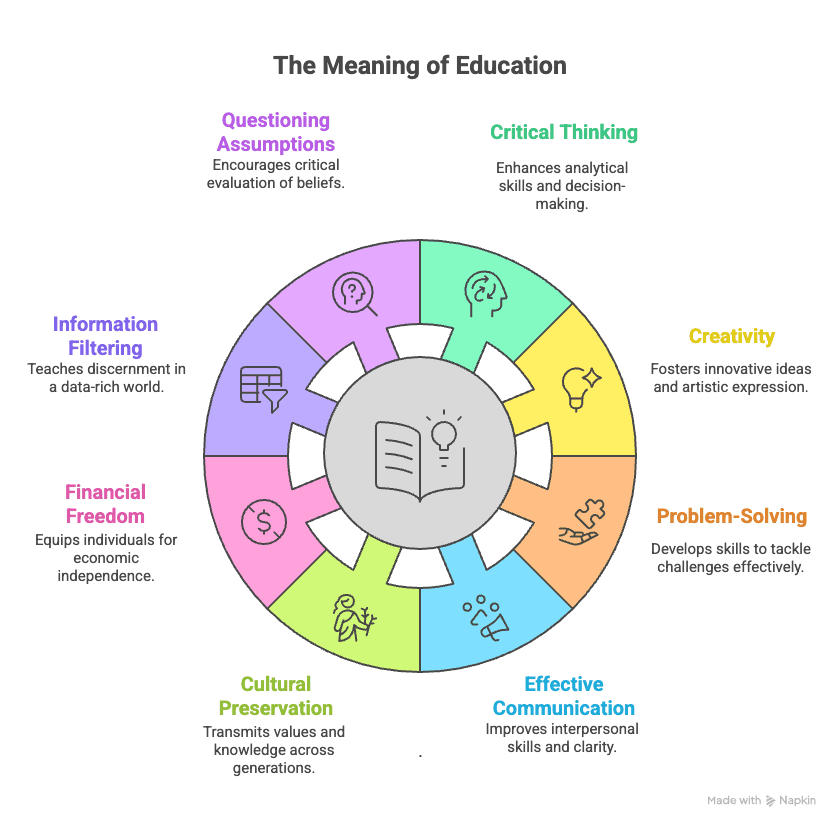
At its core, education is more than just learning facts and figures. It is a lifelong process that cultivates critical thinking, creativity, and problem-solving abilities.
Education enables individuals to understand their environment, communicate effectively, and contribute to the development of society. It helps in the transmission of cultural values and the preservation of knowledge from one generation to another.
Education is about developing the practical application of knowledge and, more importantly, learning how to think. The ability to question, distinguish valuable information from one that is not needed, and creatively applying that selected information for achieving financial freedom and living a fulfilling life. For example, a student learning percentages in Mathematics acquires an academic skill. When the same student uses percentages to calculate a discount, compare prices or understand savings, that knowledge becomes practically useful. Similarly, learning about environmental pollution in Science provides information. Understanding its causes and making informed choices about waste disposal demonstrates the application of that learning.
Education develops the entire brain, encompassing both logical/practical thinking (planning) and creative thinking (creating something from nothing). It aims to make an individual a multi-dimensional person who can think in various directions and is not confined or limited in their thinking
Education contributes to the development of several interconnected abilities:
- Intellectual development: Understanding ideas, analysing information and solving problems.
- Creative development: Exploring possibilities and finding new approaches.
- Social development: Communicating, cooperating and understanding different perspectives.
- Emotional development: Developing self-awareness, reflection and responsible behaviour.
- Practical development: Using knowledge and skills to manage real-life situations.
- Ethical development: Considering values, responsibilities and the consequences of decisions.
These dimensions show why education cannot be measured through examination marks or qualifications alone.
A person may demonstrate strong academic knowledge yet continue developing communication, judgement or practical problem-solving skills throughout life.
Education vs Schooling vs Learning: What Is the Difference?
The words education, schooling, learning are used interchangeably, but they describe related concepts with different meanings.
| Concept | Meaning | Example |
|---|---|---|
| Education | The overall or broad process of developing knowledge, skills, understanding and values | Learning to evaluate evidence and make responsible decisions for oneself |
| Schooling | Organised education provided through a formal school system | Attending school, following a curriculum and taking examinations |
| Learning | The process of acquiring or improving knowledge, understanding or abilities | Learning a language through regular conversation |
Schooling is a part of education but it does not mean that schooling is education.
Schooling provides opportunities to students to study different subjects like Maths, Science etc. and also develop communication, collaboration skills but they continue to learn beyond schools or classrooms
A person learning to prepare a household budget, understand a new technology or communicate in another language is developing useful knowledge and abilities.
Schooling is one way of receiving education, while education is a much broader lifelong process.
Types of Education : Formal, Informal and Non-Formal
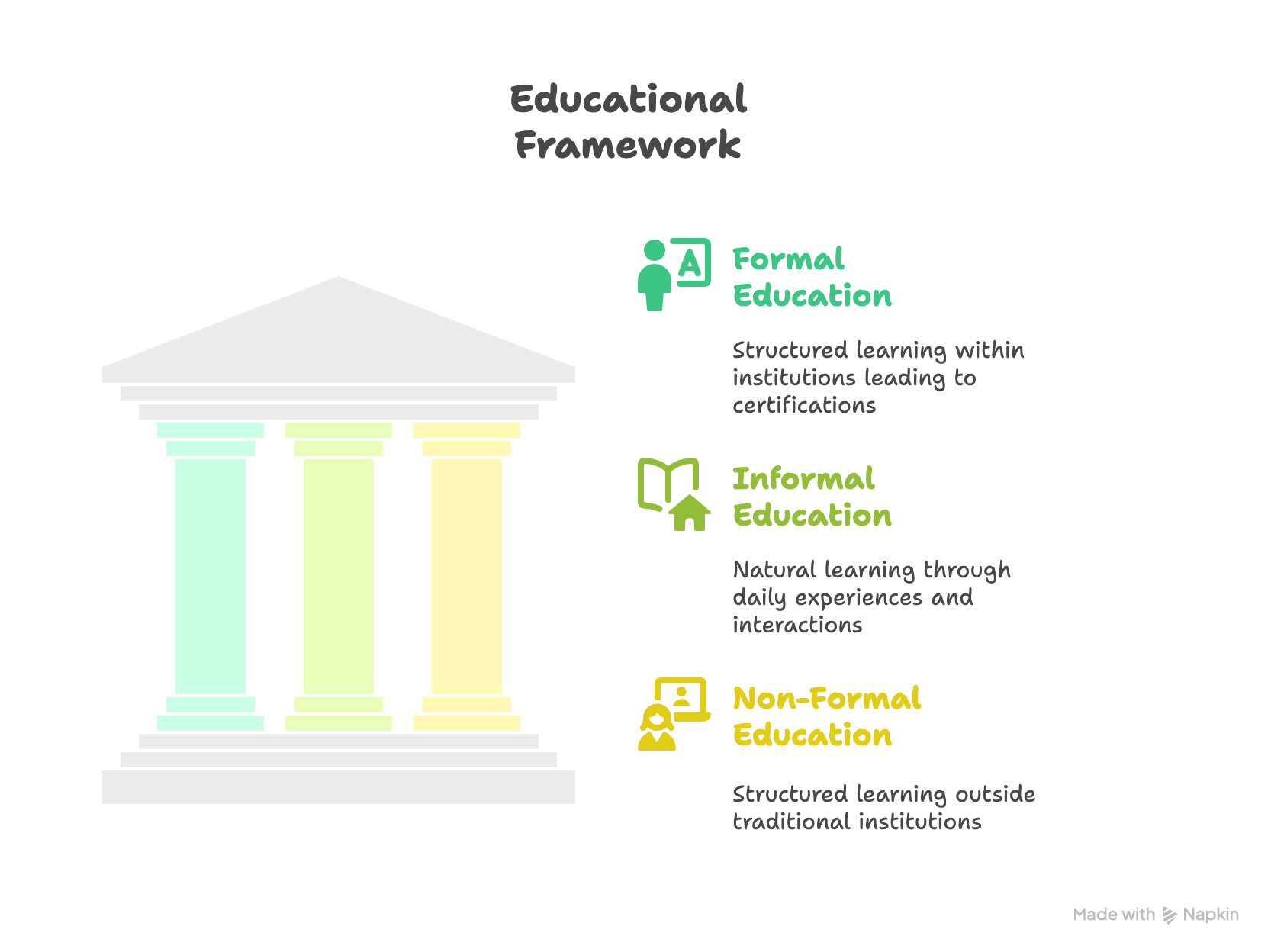
To be more clear, education can be broadly classified into three types, classifying education this way helps in understanding how learning takes place in different environments
1. Formal Education
This is structured and systematic education provided by institutions such as schools, colleges, and universities. It follows a curriculum and leads to certifications or degrees. Examples include:
- Primary and secondary schooling
- Higher education (college and university)
- Professional training programs
2. Informal Education
This type of education happens naturally through experiences and interactions in daily life. It is not structured or institution-based. Examples include:
- Learning from family and peers
- Self-study through books, online resources, or exploration
- Learning life skills from real-world experiences
Example:
A child accompanies a parent to a grocery shop and observes how prices are compared.
Gradually, the child learns basic addition, estimation and budgeting.
Although the activity is not organised as a formal lesson, it provides an opportunity to develop mathematical understanding.
3. Non-Formal Education
This is education that occurs outside the formal school system but still follows a structured format. It is often flexible and goal-oriented. Examples include:
- Online courses and workshops
- Skill development programs
- Adult literacy programs
Real-life example:
An adult attends a community workshop on basic computer skills.
The programme follows planned learning activities covering email, document preparation and online safety. It is organised and purposeful, although it may not lead to a formally recognised academic qualification.
Not every online course is non-formal education. Online learning may also be part of a recognised formal educational programme.
The Importance of Education or Why to get Educated?
Education plays an important role in individual development and can contribute to social and economic progress.
Its benefits extend beyond employment and academic achievement.
1. Personal Growth
Education enhances knowledge, improves communication skills, and develops self-discipline and confidence. It helps individuals achieve their potential and leads to self-improvement. For example, a student who learns to approach difficult Mathematics questions systematically may gradually develop greater confidence in solving unfamiliar problems.
2. Career Opportunities
A good education opens doors to better job opportunities and economic stability. Skilled individuals contribute to industries and drive economic growth. However, education alone does not guarantee employment or financial success. Access to opportunities, experience and wider economic conditions also matter.
3. Social Awareness and Responsibility
Education plays a key role in reducing inequalities, promoting gender equality, and building an informed and responsible society. It teaches moral values, civic responsibility, and cultural awareness. For example, learning about environmental problems can help individuals understand the consequences of pollution and the importance of responsible resource use.
4. Scientific and Technological Progress
Scientific discoveries, medical advancements, and technological innovations are all results of education. Educated individuals contribute to research and development, improving the quality of life.
5. Empowerment and Independence
Education empowers people by giving them the ability to think independently, make decisions, and challenge societal norms. It promotes self-reliance and reduces dependency on others.
An educated person is not necessarily someone who knows every answer, but someone who can recognise a problem, ask useful questions and seek reliable understanding.
Modern Education as an Information Filter
In the digital age, the definition of an educated mind has fundamentally shifted. We no longer suffer from a scarcity of information; instead, we suffer from an absolute overabundance of it. Therefore, a modern metric of true education is not just what you retain, but your ability to accurately filter out noise to protect your focus.
Search engines, digital libraries, videos, social media and artificial intelligence tools allow people to discover information almost instantly.
However, access to information and the ability to use it wisely are not the same.
To build a functional intellect, you must actively separate Actionable Data from the vast ocean of irrelevant online clutter. True education cultivates Critical Thinking, which acts as a shield against biased societal assumptions and media sensationalism. It trains you to look at a trending narrative, pause, and analyze its core substance rather than falling for immediate hype.
Ultimately, this filtering process is driven by Right Questioning. By developing the habit of asking deeper, objective questions, you learn to discard data that does not align with your true purpose in life. Education is the conscious choice of deciding what information you do not need, based completely on what you do not want to become.
Education is deeply connected to right questioning. It involves questioning assumptions, including the very definition of education provided by society or family. This questioning helps one understand what to do in life and, importantly, what one does not want to do.
Information Is Not the Same as Understanding
Consider a student who finds a mathematical formula online.
The student can copy the formula within seconds.
But does that mean the student understands Mathematics?
Not necessarily.
Real understanding involves knowing:
- What the formula represents.
- Why it works.
- When it should be used.
- What assumptions it depends on.
- Whether the calculated answer is reasonable.
Technology makes information easier to obtain, but meaningful education develops the ability to interpret and apply that information.
Critical Thinking in the Digital Age
Imagine that two online videos make contradictory claims about the same scientific topic.
One video has thousands of likes, while the other presents research evidence.
How should a student decide which explanation is more reliable?
A thoughtful learner might ask:
- Who created the information?
- What evidence supports the claim?
- Can the information be verified through credible sources?
- Is the explanation based on facts, assumptions or personal opinions?
- Does the conclusion logically follow from the evidence?
Rather than deciding based only on popularity, the student compares the evidence and investigates further.
This is an example of critical thinking in action.
The Importance of Asking the Right Questions
Education is closely connected with curiosity and questioning.
A student who asks “Why does this happen?” begins exploring the reasoning behind an observation.
A student who asks “Is there another way to solve this problem?” begins developing flexibility in thinking.
Consider a simple mathematical statement:
The sum of two odd numbers is always even.
A student may memorise this rule after observing:
3 + 5 = 8
7 + 9 = 16
11 + 13 = 24
But a deeper investigation involves understanding why the rule works for every pair of odd integers.
Any odd integer can be written as 2a + 1.
Another odd integer can be written as 2b + 1.
Adding them:
(2a + 1) + (2b + 1)
= 2a + 2b + 2
= 2(a + b + 1)
The result is divisible by 2, so it is even.
The student has moved beyond memorisation towards mathematical reasoning.
The value of questioning lies in developing understanding, not merely obtaining more answers.
Knowing What Information Deserves Attention
Not all available information is equally relevant to every goal.
A student preparing for an examination may benefit more from understanding important concepts and practising relevant questions than from continuously switching between unrelated online resources.
Similarly, a person developing professional skills may need to prioritise learning that aligns with their chosen direction.
However, filtering information should not mean ignoring evidence that challenges existing beliefs.
A thoughtful learner remains willing to reconsider an opinion when reliable new information becomes available.
Modern education therefore requires both focused attention and intellectual openness.
How can we better become educated?
Education is a continuous process. Improving one’s education requires more than collecting certificates or completing courses or degrees.
Here are six useful habits:
1. Remain Curious
Ask questions about everyday situations.
Why does something work? What causes a particular result? How could a problem be solved differently?
Curiosity encourages deeper exploration.
2. Read and Compare Reliable Sources
Use books, credible educational websites, research publications and other trustworthy materials.
Comparing information can help identify incomplete explanations and different perspectives.
3. Apply What You Learn
Practical application strengthens understanding.
A student studying percentages can practise calculating discounts, interpreting data or comparing savings plans.
4. Learn from Mistakes
When a solution is incorrect, investigate why the error occurred.
Understanding a mistake can be more valuable than merely copying the correct answer.
5. Explain Ideas to Others
Try expressing what you have learned in simple language.
Explaining an idea often reveals whether it has been understood clearly.
6. Continue Learning Throughout Life
Education does not end after school or graduation.
Changes in technology, work and society create new learning needs.
Lifelong learning helps people adapt, improve their skills and develop new interests.
Frequently Asked Questions About Education
What is education in simple words?
Education is the lifelong process of developing knowledge, skills, understanding and values through learning and experience. It helps people think independently, solve problems and make informed decisions.
What is the main meaning of education?
The main meaning of education is the development of human knowledge, abilities and understanding. It involves learning facts and concepts as well as developing the ability to apply them.
What are the three types of education?
The three commonly recognised types are formal, informal and non-formal education.
Formal education is organised through recognised educational programmes. Informal learning happens through daily experiences, while non-formal education consists of organised learning activities generally outside conventional formal programmes.
Why is education important in our lives?
Education can support personal development, career opportunities, social awareness, scientific understanding, communication and independent decision-making.
Is education limited to schools and colleges?
No. Schools and colleges are important educational institutions, but learning also occurs through families, communities, work, personal experiences and self-study.
What is the difference between education and knowledge?
Knowledge refers to information, understanding and familiarity acquired through learning or experience. Education is a broader process that helps individuals develop knowledge alongside skills, values, reasoning and the ability to use what they learn.
Does education end after graduation?
No. Graduation marks the completion of a particular academic programme. Individuals can continue learning and developing new abilities throughout their lives.
Conclusion
Education is much more than attending classes, memorising information or earning qualifications. It is a lifelong process that develops knowledge, skills, understanding, values and the ability to make thoughtful decisions. Formal institutions provide important educational opportunities, but learning also takes place through daily experiences, independent exploration and interaction with others. In today’s information-rich world, education has an additional responsibility: helping individuals recognise reliable information, ask meaningful questions and apply knowledge responsibly. The real value of education lies not only in how much we know, but in how clearly we understand, how carefully we question and how wisely we use what we learn.
For a deeper discussion of why education matters beyond academic learning, explore our related article: The Purpose of Education: A Lifelong Journey of Discovery and Growth.
Education is a powerful tool that transforms lives and societies. It is not just about academic achievement but also about nurturing creativity, ethical values, and life skills. Whether formal, informal, or non-formal, education is essential for personal growth, economic progress, and social harmony.
Investing in education is the key to a better future for individuals and the world as a whole.